When customers write via WhatsApp, Telegram, Viber and e-mail all at once, a business doesn’t need yet another app – it needs one window for every conversation. Using MyInboxify as an example, I explain what such a CRM is made of, the pitfalls of messaging app APIs and what a SaaS needs to have built in from day one.
What MyInboxify is and why I built it
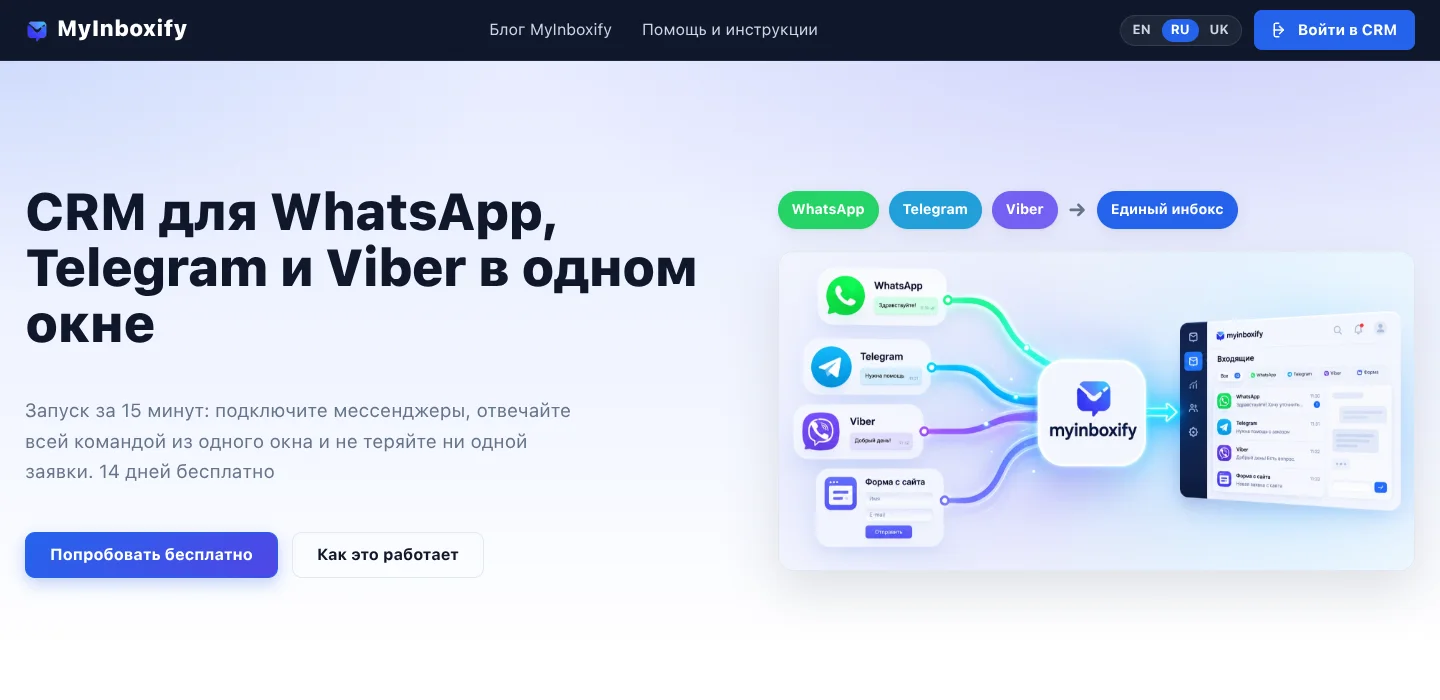
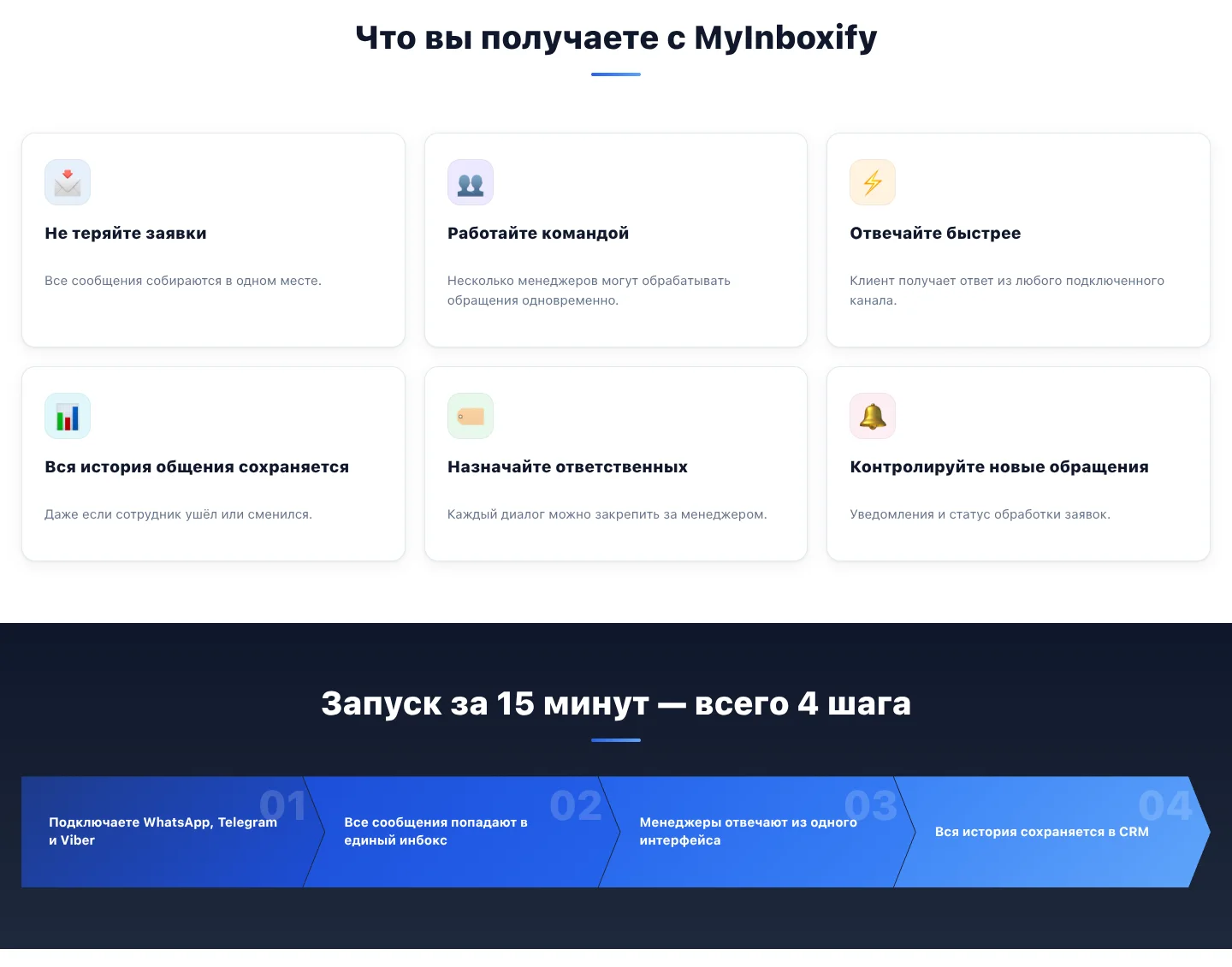
MyInboxify is a SaaS CRM for messaging apps. The idea is simple: a small company doesn’t need a heavy corporate system with dozens of modules – it needs to know that no customer message gets lost and that managers reply quickly. So all messages from the different channels land in one enquiry inbox, and working with them is designed to be learnt in a single evening.
I built the whole service: I worked out the structure and roles, wrote the back end, the dashboard interface, the integrations with the messaging apps and the payment system, as well as the marketing website with a blog and a help section. Sign-up is open, and the first 14 days are free.
Channels: WhatsApp, Telegram, Viber, e-mail and the website
Every incoming message automatically creates a contact card and an enquiry showing where it came from. Channels are connected in the settings, and step-by-step instructions are built right into the interface:
- WhatsApp – via Meta’s official WhatsApp Cloud API: the setup wizard configures the webhook, subscription and number on its own and pulls in the approved message templates
- Telegram – the company’s bot: just paste the token, and the webhook sets itself up and is restored if the platform resets it
- Viber – with the bot token
- website form – ready-made form code with custom fields, UTM tags and spam protection
- website chat – a widget with a customisable colour, greeting, chat invitation and a data processing consent line
- e-mail – when a customer replies to an e-mail, their reply goes into the chat of the same enquiry
Two-way chat and WhatsApp’s rules
Managers reply from the enquiry card, and the customer receives the message wherever they wrote from – WhatsApp, Telegram, Viber or e-mail. Every outgoing message shows its author, time and delivery status. If a message isn’t delivered, the reason and a resend button appear next to it. New messages come in without reloading the page: the unread counter updates, the tab icon flashes and a short sound plays.
WhatsApp’s rule needed special handling: free-form text can only be sent within 24 hours of the customer’s last message. Once that window has closed, the service blocks normal sending and offers a choice of approved templates – so instead of hitting a confusing error, the manager immediately sees what to do.
Team, statuses and contacts
The company owner signs up on their own and adds managers. Managers work in a shared inbox: they pick up enquiries, assign them, change statuses and leave internal notes. Each company sets up its own list of statuses to match its process, and the activity log shows who changed a status, replied or sent a template, and when.
- one open enquiry per contact: a new message from the same customer is added to it instead of creating duplicates
- duplicate detection by phone number and merging of contact cards with the whole conversation history
- search, filters and export of enquiries and contacts to a CSV file that opens correctly in Excel
- for enquiries from the website form – a “Call” button and a mark that the call has been made
A Telegram group with topics, notifications and analytics
Many teams are used to working in Telegram, so I built a mirror of enquiries in a supergroup with topics. Each enquiry gets its own topic with the customer card and “Take” and “Close” buttons. The customer’s messages from any channel are copied into the topic, and a manager’s reply sent straight from Telegram reaches the customer wherever they wrote from. Echo protection stops messages from going round in circles, and different companies’ data never mixes.
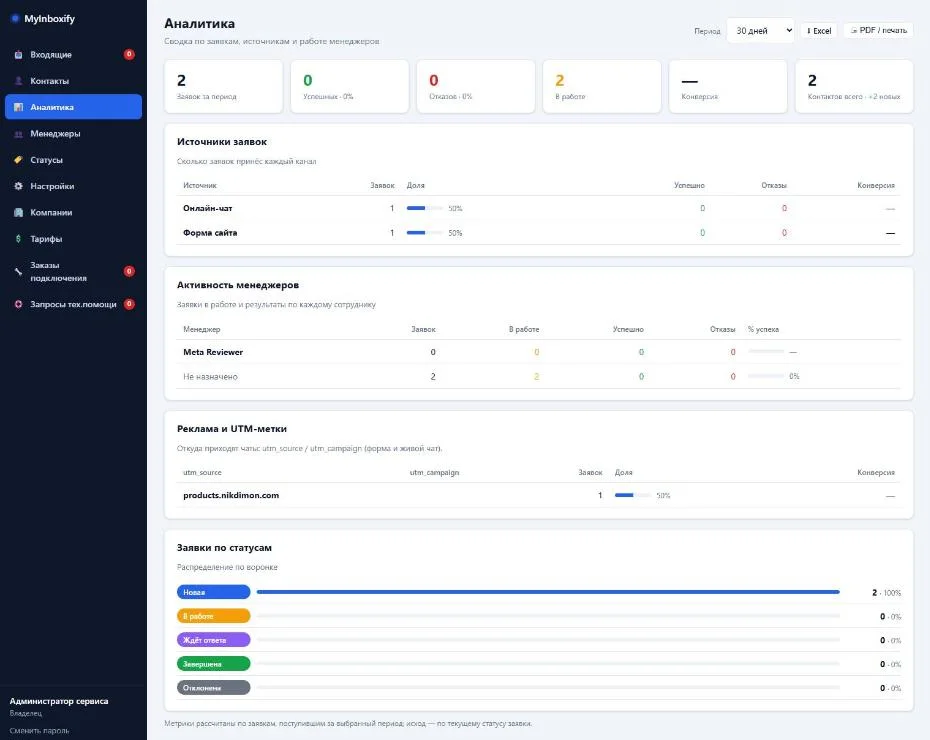
The service announces each new enquiry in the company’s Telegram chat, the assigned manager gets a personal notification, and enquiries left unanswered for more than three hours are collected into a reminder. The analytics show enquiries, closed deals and sources; the higher plans add manager workload, channels, UTM tags and statistics export to Excel and PDF.
Plans, payments and five languages
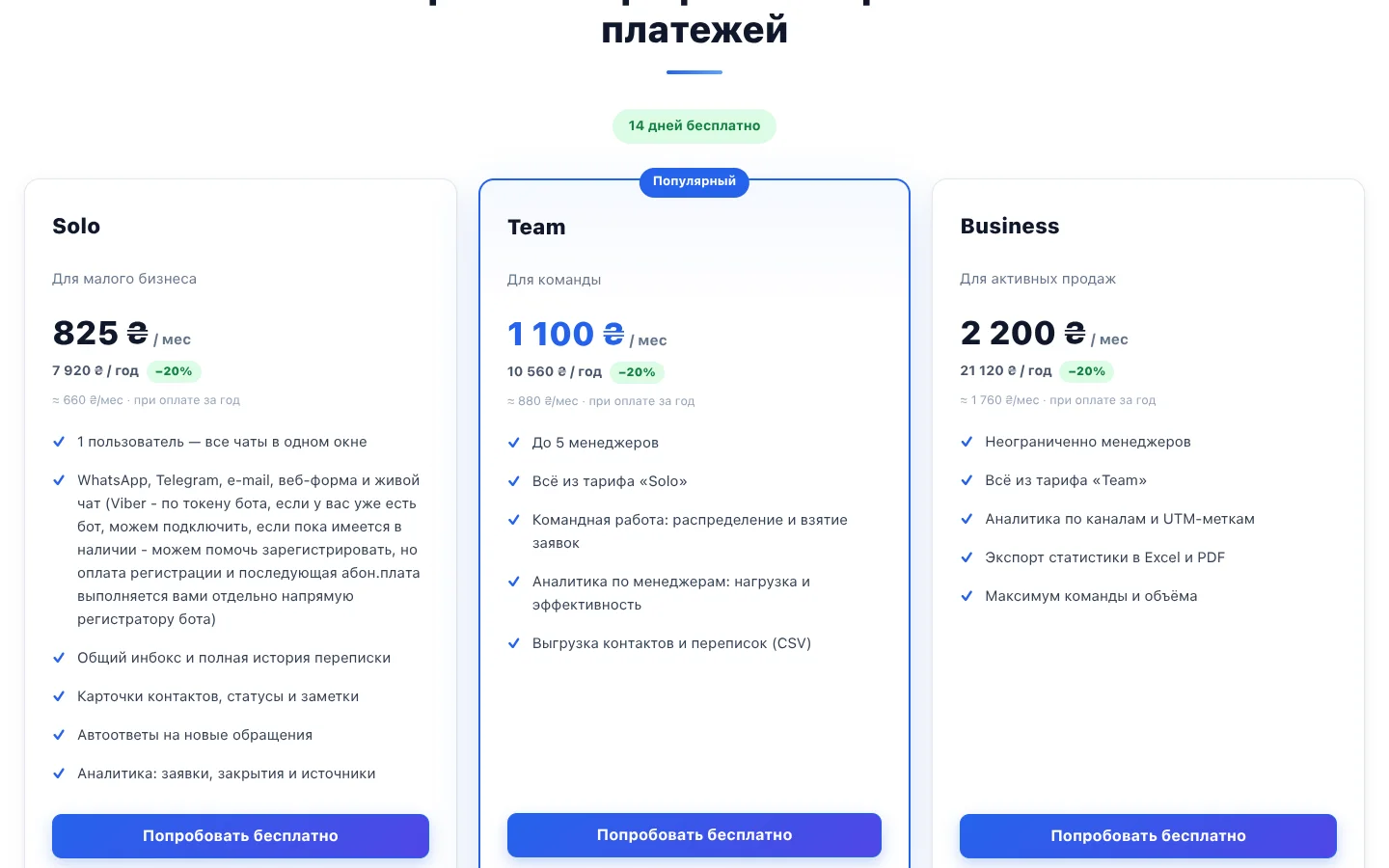
I built payments right into the service: the three plans differ in the number of managers and the depth of the analytics, and customers can pay monthly or yearly at a discount. Subscriptions run through Stripe with a free trial, customers update their card and get receipts in the Stripe customer portal, and a plan change takes effect at the end of the paid period. The prices on the marketing website are pulled from the service’s admin panel, so they always match.
The interface is fully translated into English, Russian, Ukrainian, French and German. The language can be set right in the page URL – handy for ads aimed at different countries – and the login and sign-up pages have canonical and hreflang tags. For those who don’t want to set everything up themselves, there is a one-off onboarding service: customers pay for it on the website, and the order goes straight into the admin panel.
Security and reliability of a SaaS
In a multi-tenant service, other people’s data is the biggest responsibility, so I built company isolation into every database query: one company can’t see another’s data, even by putting someone else’s record number into the page URL.
- channel tokens are stored encrypted, and passwords only as hashes
- incoming webhooks are verified by signature, and forged messages are rejected
- brute-force protection, CSRF tokens on every action and a strict content security policy
- the website form is protected by bot traps, per-IP limits, a list of allowed domains and an optional CAPTCHA
- daily database backups and regular scheduled webhook checks
What to consider if you need your own CRM or messaging app integration
If you are planning a CRM for messaging apps, a WhatsApp Business API integration or your own customer service tool, the experience of MyInboxify suggests thinking through a few things from the very start:
- each platform’s rules – the 24-hour window and templates in WhatsApp, the specifics of bots in Telegram and Viber
- delivery and errors – managers need to see whether a message was delivered and be able to resend it
- duplicate contacts – the same customer writes from different channels
- data isolation, if several companies use the service
- payments and plans – free trial, renewal, changing plans
- easy onboarding – the fewer technical steps a customer has to take, the more likely they are to stay
I build web services and integrations tailored to the task – from a small “website form → Telegram” link to a full SaaS platform with payments and teamwork.
Project details
Project typeweb service (SaaS)
CategoryWeb service / SaaS
TechnologiesPHP 8.1, MariaDB, WhatsApp Cloud API (Meta), Telegram Bot API, Viber API, Stripe, IMAP/SMTP, JavaScript, WordPress
Roleend-to-end SaaS development: architecture, back end, interface, integrations, marketing website
ClientMyInboxify
CountryInternational (EN/RU/UK/FR/DE)
What was done
- Designed a multi-tenant architecture with isolated company data
- Connected the WhatsApp Cloud API, Telegram Bot API, Viber, the website form and chat, and e-mail
- Built two-way chat with delivery statuses and WhatsApp templates
- Built teamwork: managers, assignments, statuses, notes, activity log
- Implemented contacts with duplicate search and merging, and CSV export
- Created a mirror of enquiries in a Telegram supergroup with topics and replies straight from Telegram
- Added analytics, notifications and reminders about unanswered enquiries
- Built in plans and Stripe subscriptions with a free trial
- Translated the interface into five languages and built the marketing website on WordPress
Result
- A working SaaS with open sign-up and 14 days free
- Messages from six channels in one enquiry inbox
- The team replies to customers from one window or straight from Telegram
- Subscription payments built into the service through Stripe
- An interface in five languages for different markets
Visit the project website