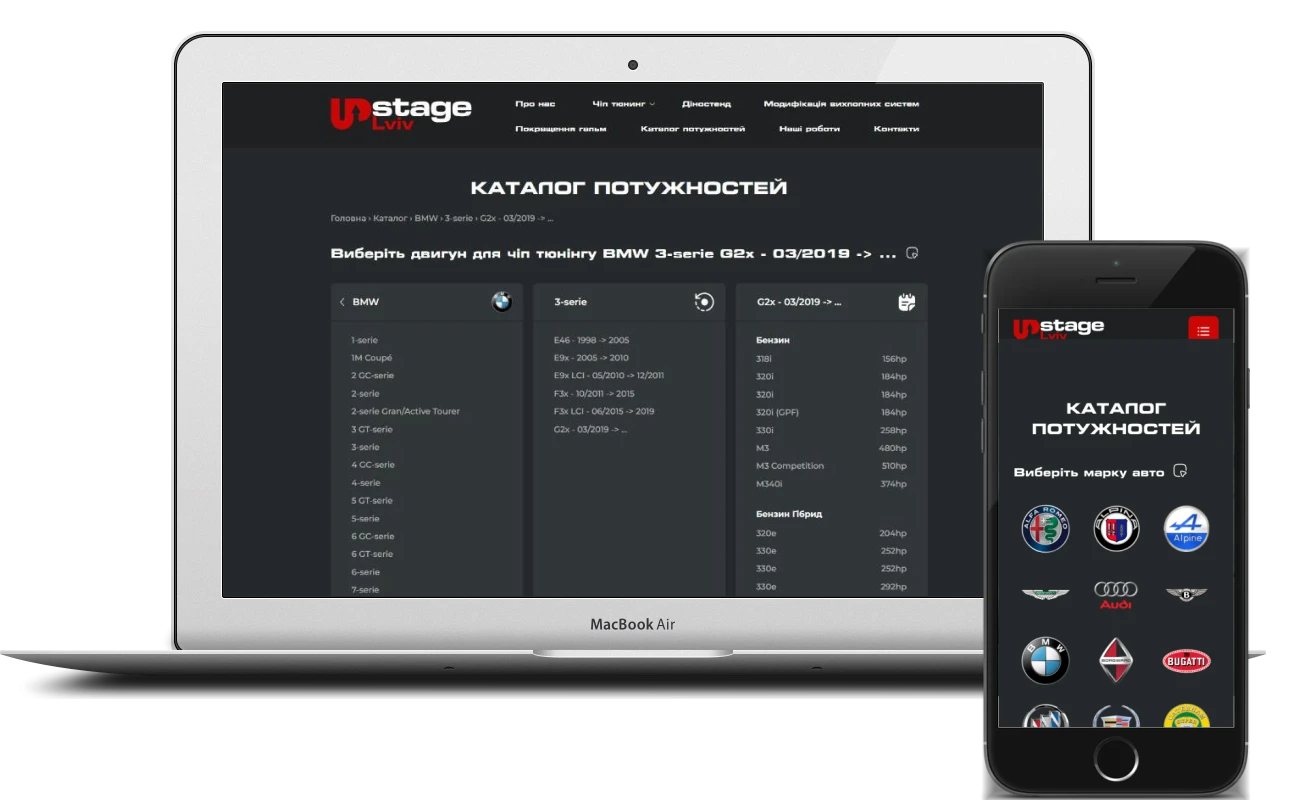
In tuning, customers compare numbers, not slogans. So the most useful thing a studio’s website can offer is an honest answer to the question “how much will my car gain?”. Here is how I built a power catalogue of thousands of engines for UPstage Lviv and linked it to the service pages and enquiry forms.
The brief: answer the car owner’s main question
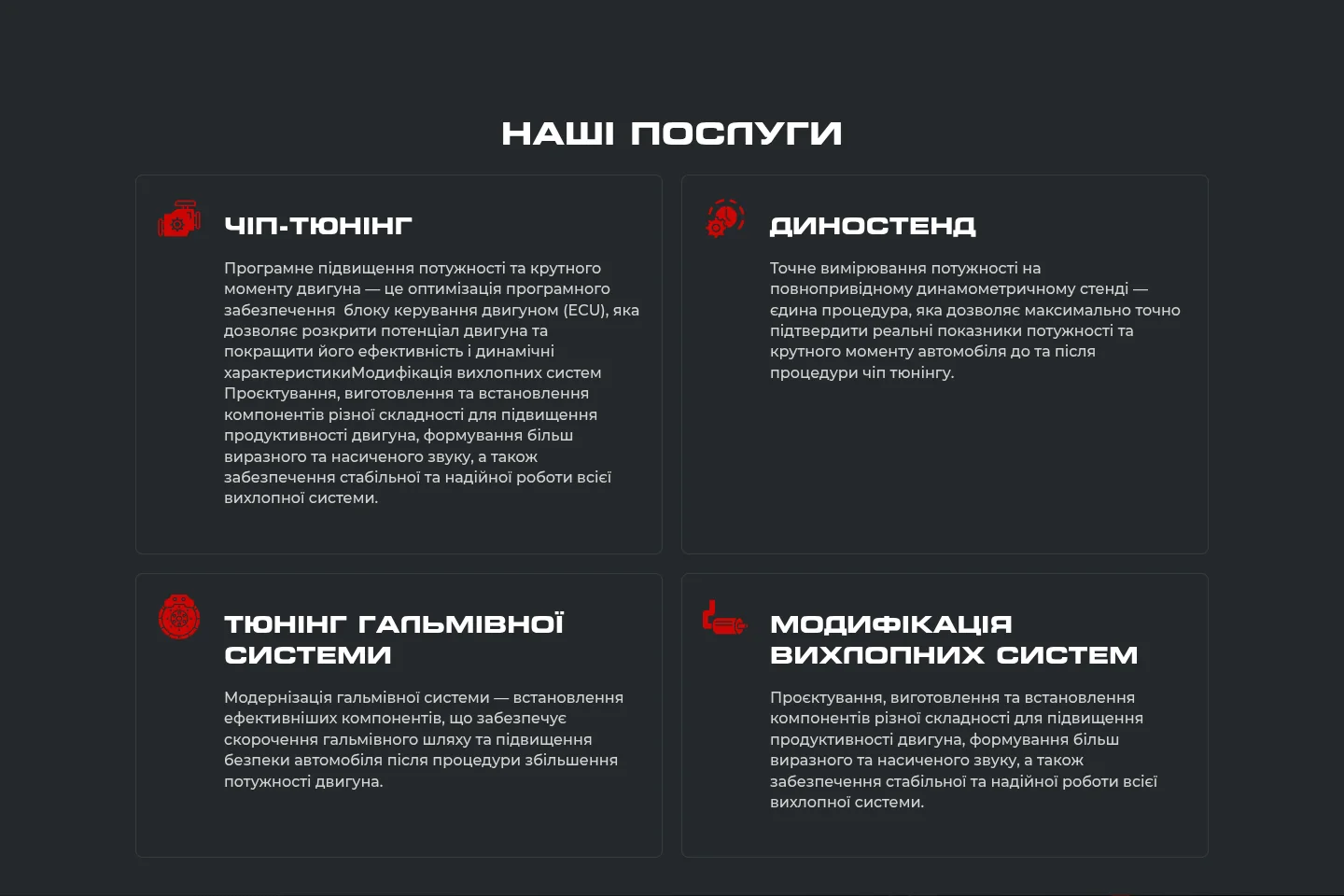
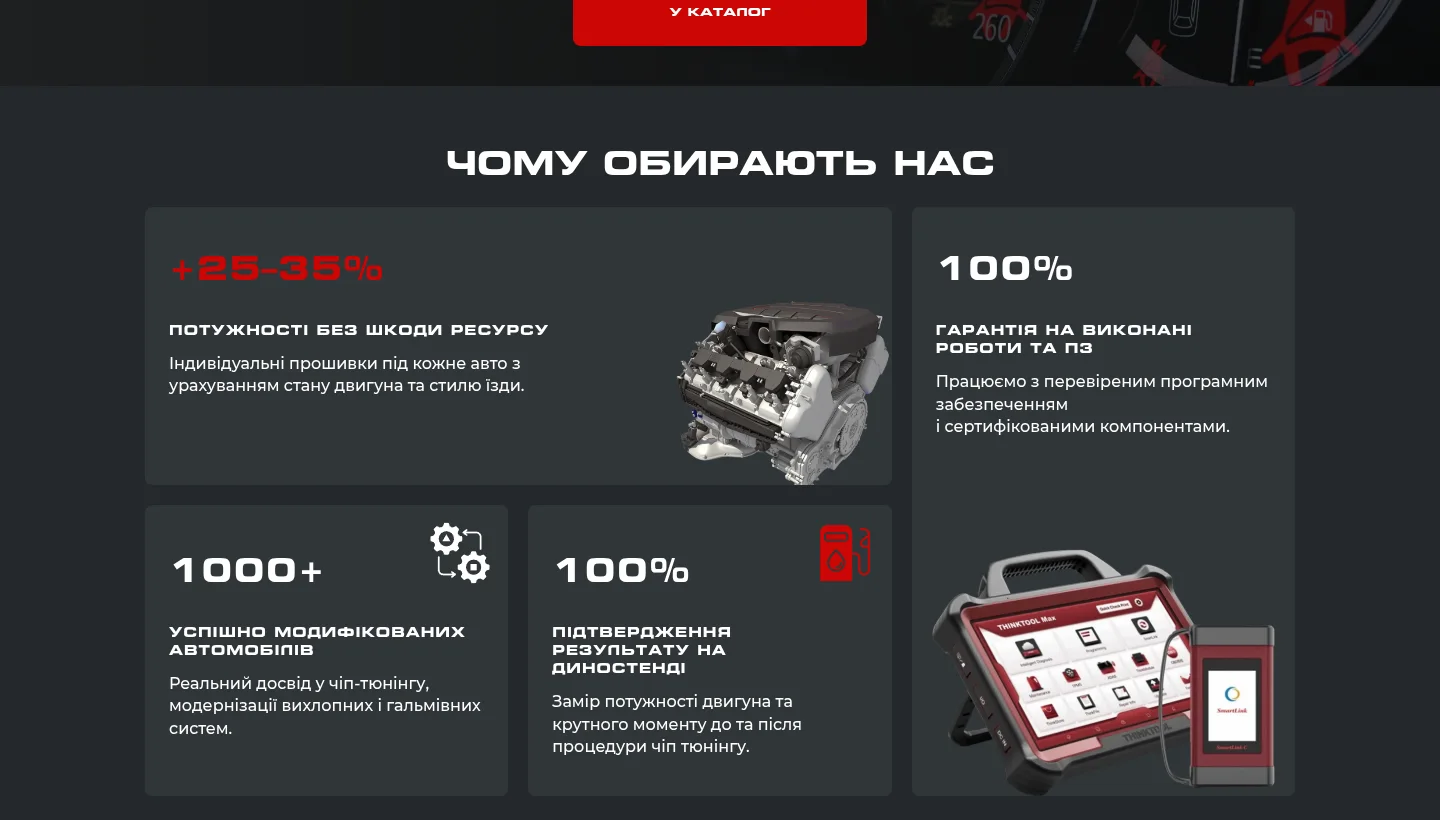
UPstage Lviv is the official Upstage Chiptuning partner in Lviv. The studio offers Stage 1, 2 and 3 chip tuning, automatic gearbox remaps and pops and bangs tunes, software DPF, EGR, AdBlue, FLAPS and OPF delete, ECU unlocking, and also upgrades exhausts and brakes. The results are checked on an all-wheel-drive dyno.
Someone thinking about chip tuning comes with a specific question: how many horsepower and newton metres will Stage 1 add to my engine, and how much will it cost? Generic promises like “plus 20–30%” don’t convince them. That’s why the power catalogue became the centre of the website, while the service pages explain exactly what happens to the car.
How the power catalogue works
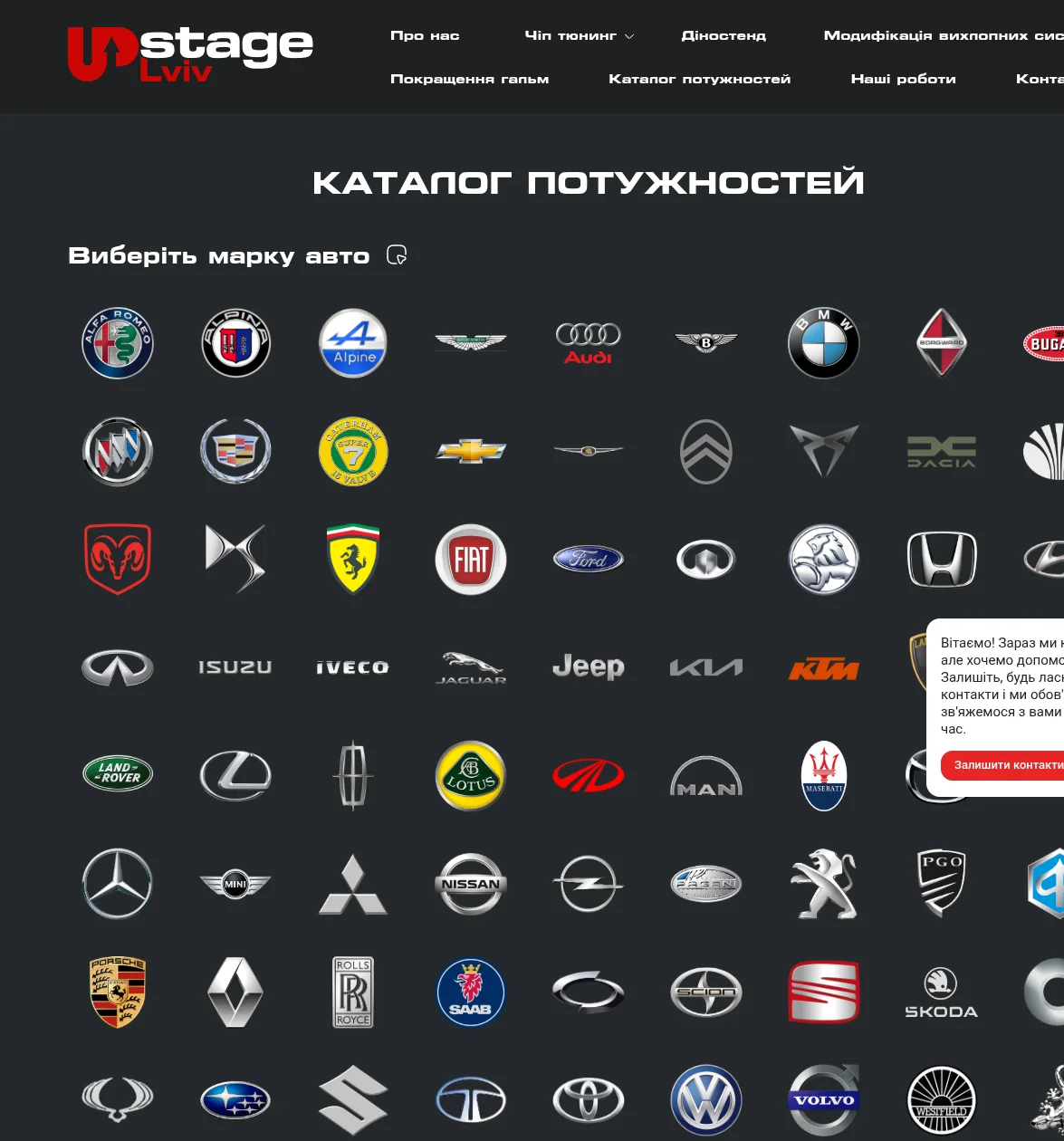
The catalogue sits at the very top of the home page: a grid of make logos and the prompt “Choose your car make”. From there, it’s four steps:
- make – 72 makes from Alfa Romeo to Wiesmann, each with its own logo
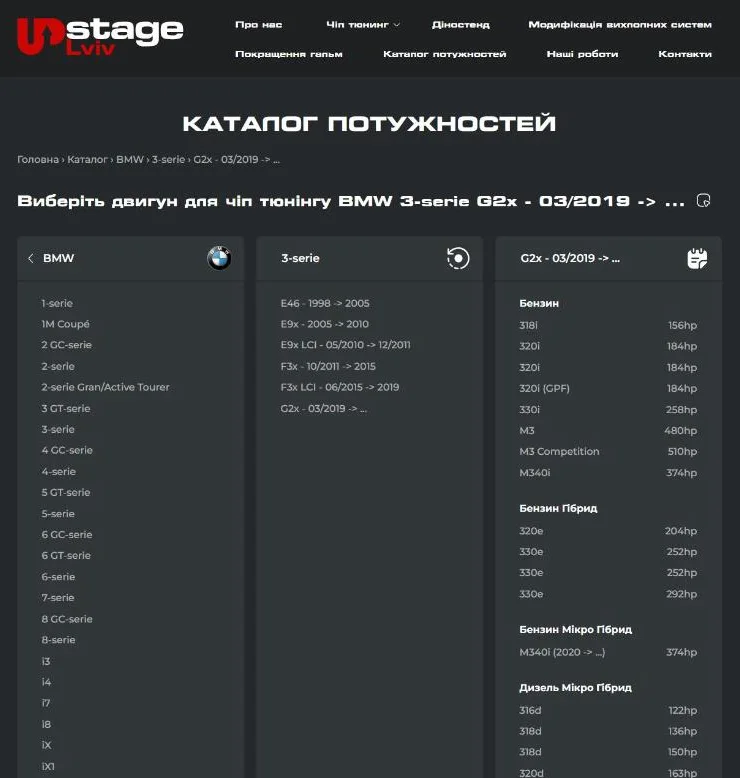
- model – BMW alone has more than forty, from the 1 Series to the Z8
- generation with production years – for the 3 Series that means E46, E9x, F3x, G2x and their facelifts
- engine – grouped by fuel type (petrol, hybrid, diesel), with the factory output shown right next to each one
Every level has breadcrumbs and side switches for “Model – Year – Engine”, so the neighbouring generation or engine is one click away. In total, the catalogue holds 72 makes, about 800 models, more than 1,500 generations and over 8,000 engine pages. Technically, these are nested WordPress categories and posts, and the make logos are attached to the categories, so the client manages the catalogue in the standard admin area.
The engine page: stock vs Stage
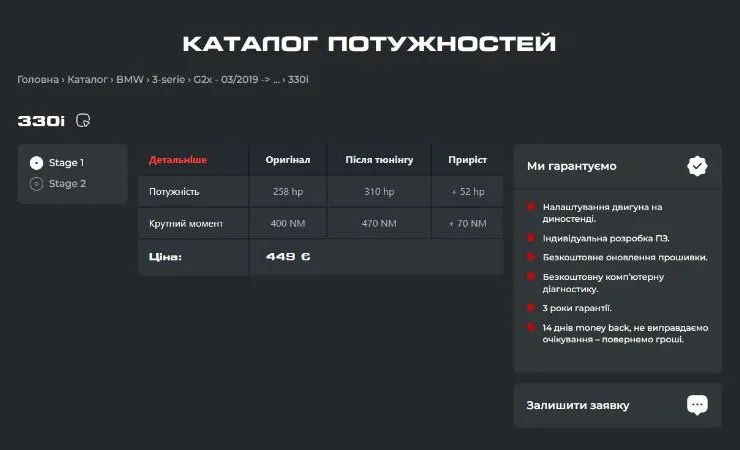
This is the main sales page. Taking the BMW 330i (G2x) as an example, it looks like this:
- Stage 1 and Stage 2 tabs
- an “Original – After tuning – Gain” table for power and torque: for Stage 1 that’s 258 → 310 hp and 400 → 470 Nm
- the price – €449 for Stage 1, “on request” for Stage 2
- what the work includes: dyno tuning, a custom map, free updates and diagnostics, a 3-year warranty and a 14-day money-back guarantee
- a “Send a request” button
The enquiry form automatically adds the URL of the page it was sent from. The manager immediately sees the make, model, generation and engine, and doesn’t waste the first call on questions.
Thousands of pages for search
Each engine page is a separate landing page for a search such as “chip tuning BMW 330i”. The title and description are built from a template using the engine, model, generation and city, for example: “Chip tuning 330i BMW 3-serie G2x… in Lviv – Stage 1 / Stage 2, Dyno”. Yoast SEO splits the sitemap into parts of a thousand entries each, so search engines can crawl the whole catalogue without trouble.
Service pages
Besides the catalogue, every service has its own page:
- Stage 1, Stage 2 and Stage 3 – what changes in the software and the hardware, what gain to expect and how the procedure goes step by step
- automatic and DSG gearbox remaps, pops and bangs tunes, software emissions system delete, ECU unlocking
- the dyno – its specifications: up to 1,000 hp and 1,300 Nm per axle, speeds up to 280 km/h, two- and four-wheel drive
- exhaust and brake upgrades – with photos of completed work
At the bottom of the service pages there is a recurring block with Stage 1, 2 and 3 and ECO tuning: someone who came for an exhaust also sees everything else the studio can do.
Our work, contact details and enquiries
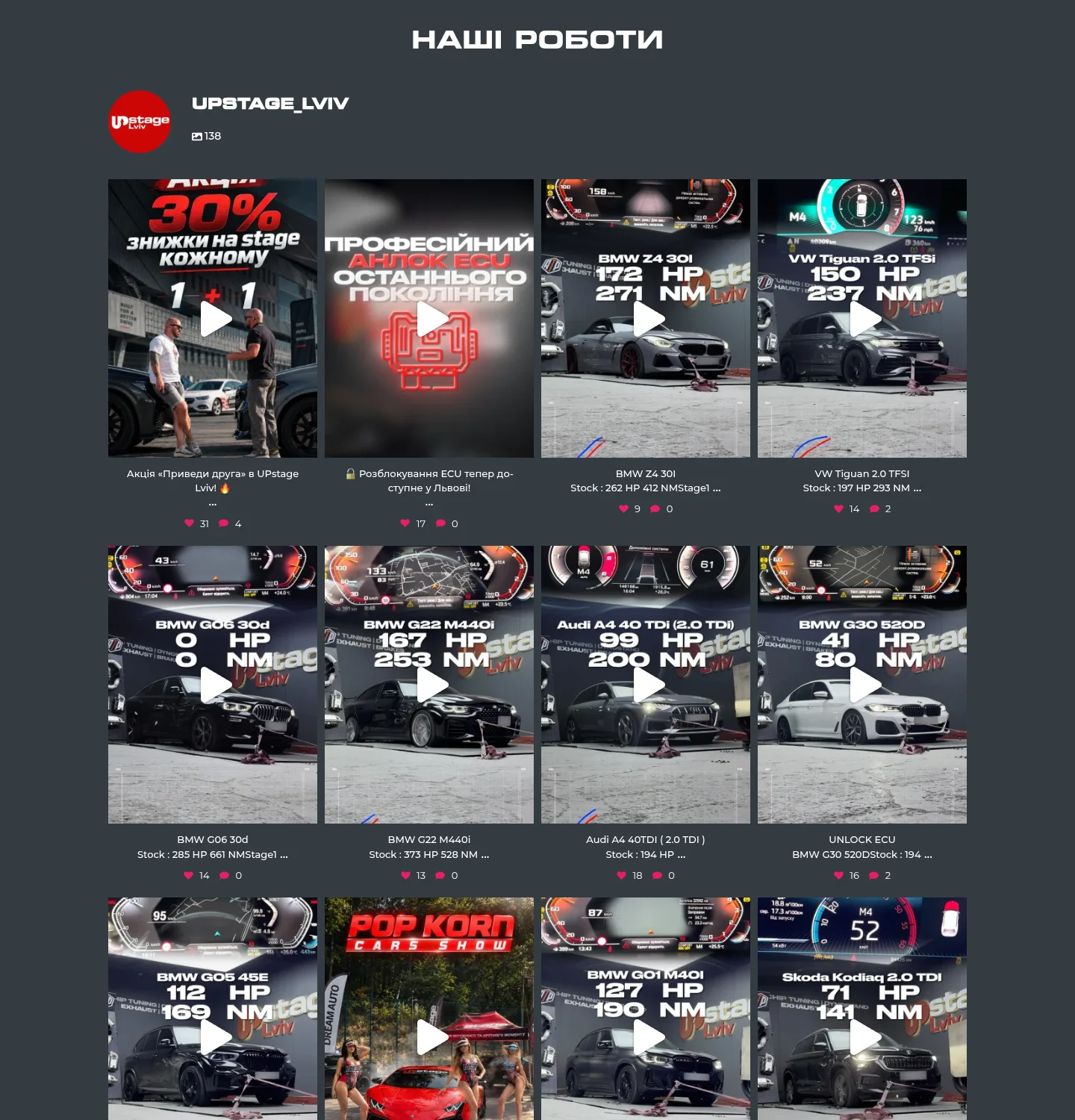
The “Our work” section and a block on the home page show the studio’s Instagram feed via Instagram Feed Pro: posts with dyno figures such as “Stock: 262 HP 412 NM → Stage1: 307 HP 483 NM” and a “Load more” button. In tuning, this is the most convincing portfolio there is – real cars and real numbers.
The first screen has links to Facebook, Instagram, TikTok and YouTube and a “Book your tuning” button. A contact block with the address, phone number, e-mail and a short form (name and phone with an input mask) appears on most pages, and the contact page also has a Google map. Site Kit by Google and the Google Ads tag are connected for analytics.
Why a tuning studio needs a power catalogue
In chip tuning, customers compare numbers. A power catalogue does several jobs at once:
- it answers the first question without a phone call – people see the gain for their engine and decide whether the trip is worth it
- it brings people in from search – queries with the make, model and engine are more precise and closer to a decision than a generic “chip tuning Lviv”
- it sets expectations in advance – customers arrive knowing which figures are realistic, and the dyno confirms them
- it makes enquiries more precise – each one includes a link to a specific engine
What else matters on a garage or tuning studio website
A catalogue is a powerful tool, but it isn’t enough on its own. From the experience of this project, a studio website should also include:
- proof of results – before and after figures, photos and videos from the dyno, recent work from social media
- clear prices, or at least a guide – “from” and “on request” are more honest than saying nothing at all
- a simple explanation of the services: how Stage 1 differs from Stage 2, what needs changing on the car for Stage 3, what a gearbox remap gives you
- booking in a couple of taps – a short form with a name and phone number and a call button, especially if the studio works by appointment
- the address and a map – people often travel to a tuning studio from other cities, and the entrance should be easy to find
- a good experience on smartphones – people often look up their make, model and engine on their phone, standing next to the car
If you are commissioning a website for a garage or tuning studio, think about three things in advance: where the catalogue data will come from, how it will be updated and how enquiries will reach the manager. A catalogue of thousands of pages should be managed from the standard admin area, not by a developer by hand – otherwise it will quickly go out of date.
Project details
Project typeservices website with a catalogue
CategoryWordPress website
TechnologiesWordPress, custom burum theme, PHP, JavaScript (jQuery), Contact Form 7, Instagram Feed Pro, Category Images, Yoast SEO, Site Kit by Google
Rolewebsite development: structure, front-end on my own theme, power catalogue, enquiry forms, SEO set-up
ClientUPstage Lviv
CountryUkraine
What was done
- Planned the power catalogue: make → model → generation → engine on nested WordPress categories
- Placed a grid of 72 make logos at the top of the home page and in the catalogue
- Built the engine page template with Stage 1 / Stage 2 tabs, a gain table and the price
- Added side switches for model, generation and engine, plus breadcrumbs
- Set up SEO title and description templates for thousands of engine pages
- Built the service pages: Stage 1/2/3, automatic gearboxes, emissions systems, pops and bangs, dyno, exhausts, brakes, ECU unlock
- Connected the Instagram feed in the “Our work” section and on the home page
- Set up enquiry forms with a phone input mask and a link to the engine page
- Connected Yoast SEO, Site Kit by Google and the Google Ads tag
Result
- A catalogue of 72 makes, about 800 models, more than 1,500 generations and over 8,000 engines
- Every engine has its own page with the gain, the price and an enquiry form
- Enquiries from the catalogue arrive with a link to the engine in question
- The studio’s work with dyno figures is shown on the site straight from Instagram